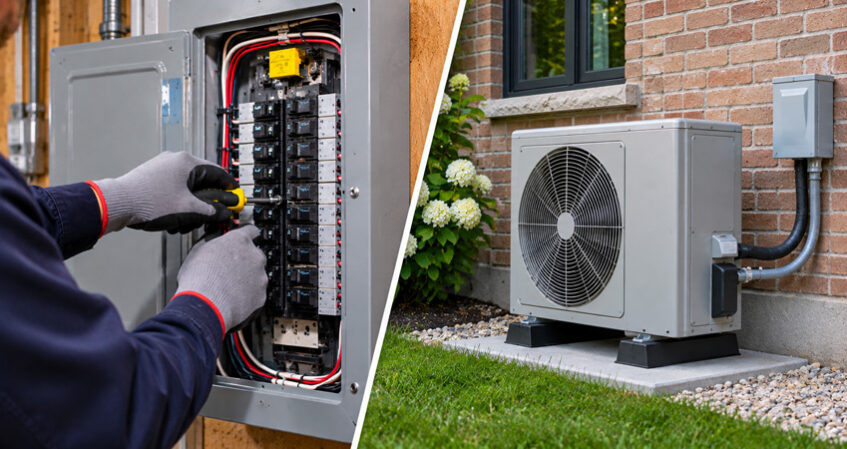
Most homes with a 200-amp electrical panel can handle a heat pump without an upgrade. Many homes with 100-amp service can too, but only after a load calculation confirms there’s enough capacity, especially if the system includes electric backup heat or you also plan to add an EV charger.
Heat pumps are a hot topic in Ontario thanks to new rebates and a shift away from gas heating. Before you sign an HVAC quote, check whether your electrical system is ready.
Key Takeaways
- A heat pump needs its own dedicated 240-volt circuit, usually between 15 and 40 amps depending on the unit
- Electric backup heat strips are often a bigger load than the heat pump itself
- On 100A service, a load calculation decides whether you need an upgrade, a load manager or nothing at all
- A heat pump plus an EV charger is where many 100A homes run out of capacity
Why a Heat Pump Affects Your Electrical Panel
A gas furnace uses very little electricity, mostly to run the blower fan. A heat pump does all of its heating with electricity, running a compressor and an outdoor fan for much of the year. In very cold weather, many systems also switch on electric backup heat.
If the heat pump replaces an existing central air conditioner, some of that circuit capacity is already accounted for. But heat pumps are often larger than the AC they replace, and backup heat adds a significant new load.
To know whether your panel can handle it, a licensed electrician performs a load calculation under the Ontario Electrical Safety Code. It looks at your home’s size, major appliances and heating loads, not just the number of breakers in the panel.
Heat Pump Electrical Checklist
1. Panel and Service Size
Check the main breaker at the top of your panel. A 200A main generally has room for a heat pump. A 100A main needs a load calculation. A 60A service or a fuse box will almost always need an upgrade first. Keep in mind that a 200A-rated panel can still be fed by a 100A service, so the main breaker and the service size both matter.
2. Free Breaker Space
A 240-volt heat pump needs a double-pole breaker, which takes two spaces. If your panel is full, the options are tandem breakers where the panel allows them, a subpanel or a panel replacement.
3. A Dedicated Circuit
The outdoor unit needs its own circuit, sized to the maximum breaker rating on the unit’s nameplate, along with an outdoor disconnect switch. The indoor air handler may need a separate circuit as well. Heat pumps join a long list of appliances that require a dedicated electrical circuit.
4. Backup Heat Strips
Electric backup heat usually ranges from 5 to 15 kW. A 10 kW strip alone draws over 40 amps at 240 volts, which can tip a 100A panel over its limit. Two common ways to avoid this are a dual-fuel setup, where your existing gas furnace provides backup heat, or smaller strips sized from a proper heat-loss calculation.
What If You Add a Heat Pump and an EV Charger?
This is one of the most common questions we hear. A Level 2 EV charger on a 40-amp circuit draws 32 amps while charging. Combined with a heat pump and electric backup heat on a cold night, a 100A service often doesn’t have enough room.
You have two main options:
- Upgrade to 200A service to give both loads the capacity they need, with room left for future additions
- Install a load management device that pauses or slows EV charging when your heating demand peaks, which the code allows in many cases
We cover the EV side in more detail in our post on installing an EV charger with a 100-amp panel. If you’re planning both, do one load calculation for the whole house. Combining the work into one permit and one visit usually saves money.
Heat Pump Rebates in Ontario
Rebates can cover a meaningful share of the cost of the heat pump itself. Through the Home Renovation Savings Program, delivered by Enbridge Gas and Save on Energy with support from the Ontario government, current offers include:
- Up to $7,500 ($1,250 per ton) for a cold-climate air source heat pump in homes primarily heated by electricity, oil, propane or wood
- Up to $2,000 ($500 per ton) for Enbridge Gas customers who primarily heat with natural gas
The heat pump must be on Natural Resources Canada’s qualified products list, pre-approval is required, and a participating HVAC contractor must submit the application.
The federal government has also announced a National Heat Pump Rebate of $2,000 for most eligible households and up to $10,000 for households below the median income. Applications are expected to open in early 2027, and installations completed on or after November 1, 2026, may qualify.
Rebates generally don’t cover electrical upgrades, and program details change often, so confirm current terms before you book.
Frequently Asked Questions
Can a 100-amp panel handle a heat pump?
Often, yes. Many 100A homes can support a heat pump, especially one paired with gas backup heat. A load calculation is the only reliable way to confirm it.
What size breaker does a heat pump need?
Most residential heat pumps use a 240-volt double-pole breaker between 15 and 40 amps. The correct size is listed on the unit’s nameplate. Electric backup heat needs its own, often larger, circuit.
Do I need an ESA permit to install a heat pump?
Yes. The electrical work for a heat pump must be reported to the Electrical Safety Authority. Learn more in our ESA permit guide.
Do heat pump rebates cover a panel upgrade?
Generally, no. Current Ontario and federal rebates focus on the heat pump itself, so plan for electrical upgrades as a separate cost.
Get Your Home Heat Pump Ready
At SiteTech Electrical, our ESA-licensed team (Licence #7013789) handles load calculations, dedicated circuits and panel upgrades for heat pump and EV projects across the GTA. Explore our residential electrical services, or call us at (647) 939-3239 to request a free estimate before your heat pump install.